AI reached mass adoption in under three years, five times faster than the World Wide Web. This acceleration is impossible to ignore in the travel sector: over 80% of travel agencies are now using some form of AI, with 90% reporting measurable efficiency gains (Zipdo). For corporate travel specifically, 70% of buyers intend to integrate AI tools into their platforms within the next three years, and 87% of business travelers are ready to engage with AI-driven services (Direct Travel).
This isn’t a trend anymore. For Travel Management Companies (TMCs), AI represents an inflection point where operational maturity and innovation are no longer separate goals, but converge into a single strategic, imperative conversation.
The Implementation Trap
As TMCs face shifting supplier models, growing demands for traveler autonomy, and increasingly complex servicing requirements, many view AI as the obvious, topical, and effective solution.

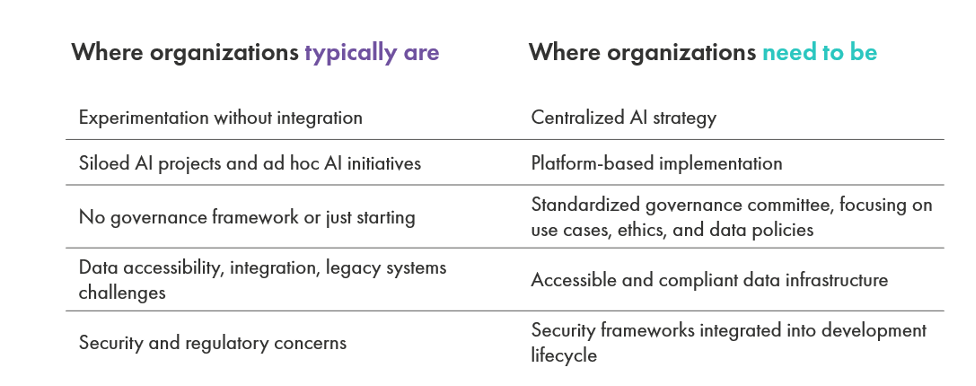
However, simply adding AI-enabled features to existing systems does not futureproof platforms and services or improve internal workflows and operational efficiency.
Contrarily, now is more crucial than ever to consider AI implementation in a way that intentionally builds long-term advantage and aligns with the TMC’s strategic goals.
In fact, rushing into AI adoption without a clear, structured approach often leads to the emergence of “new legacy” systems: AI tools implemented just 2 or 3 years ago that are already misaligned with evolving needs or broader digital architecture. These technically modern systems weren’t built around actual business requirements or designed for future integration, creating the need for rework, replacement, or full modernization. For TMCs navigating rapid change, this is a critical warning: if your AI investment isn’t aligned with long-term goals, you’re not innovating. You’re laying the groundwork for your next modernization cycle.
What Good Implementation Looks Like
Today, well-implemented AI is already reshaping legacy workflows. Fare searches once handled by trained agents using complex GDS commands are being replaced by intelligent offer engines, creating personalized itineraries and pricing in seconds. Manual servicing gets augmented by predictive tools that spot itinerary risks before they become problems. Personalization, previously dependent on high-touch agent experience, is increasingly driven by real-time traveler data processed through machine learning and synthesized by an agent for customers.
These changes don’t just have the potential to cut costs. They hold a prospect for entirely repositioning the TMCs’ value proposition and challenge the role of traditional “scripting” in agency environments. With Generative and Agentic AI, TMCs could optimize operational efficiency, expedite basic tasks, dynamically generate itineraries based on company travel policies, suggest cost-saving alternatives in real time, flag compliance risks, and predict traveler satisfaction based on historical travel data and friction patterns. A single AI agent can accomplish what multiple concurrent scripts used to handle.

Strategic Implementation Over Shiny Tools
Like any tool, AI's impact depends entirely on implementation intelligence. TMC leaders must align technology choices with business architecture and strategy. This means investing in clean data pipelines, interoperable systems, and talent that understands both the tech stack and the travel ecosystem. It also means choosing solutions that drive measurable, long-term business outcomes over impressive feature lists.
The Human Advantage
Intelligent and purposeful AI implementation can potentially create space for “The Human Element” to resurface—and this applies beyond TMCs! The more AI becomes embedded in travel operations, the more room emerges for distinctly human value. Agents and account managers can focus on traveler empathy, consultative selling, and proactive relationship management.
Leadership in this era is not defined by who deploys the most AI features or gets there first. It will be shaped by those who align AI with their strategic and business vision, freeing their teams to do what only humans can.
AI may book flights, rearrange itineraries mid-air, and ensure compliance. But it will never replace the trust travelers place in a great travel partner. That’s your competitive edge. Tech isn’t the differentiator. The way you wield it is.
Ready to explore AI's potential for your travel operations?
DataArt’s Travel Agency Solutions team brings deep expert travel expertise to create platforms that evolve with your needs. Learn more about our solutions or get in touch!