

Intelligent document processing for aviation is becoming a control layer. It turns PDFs, scans, and screenshots into auditable, system-ready data so modern platforms can run with fewer manual handoffs.
Airlines, airports, ground handlers, and MRO providers have all invested heavily in modern systems. The promise is speed, cleaner integration, and tighter control of margin and service quality.
Yet many programs still slow down in the same place: documents. Critical operational and financial inputs still arrive as artifacts, and systems still can’t reliably convert them into usable data at scale.
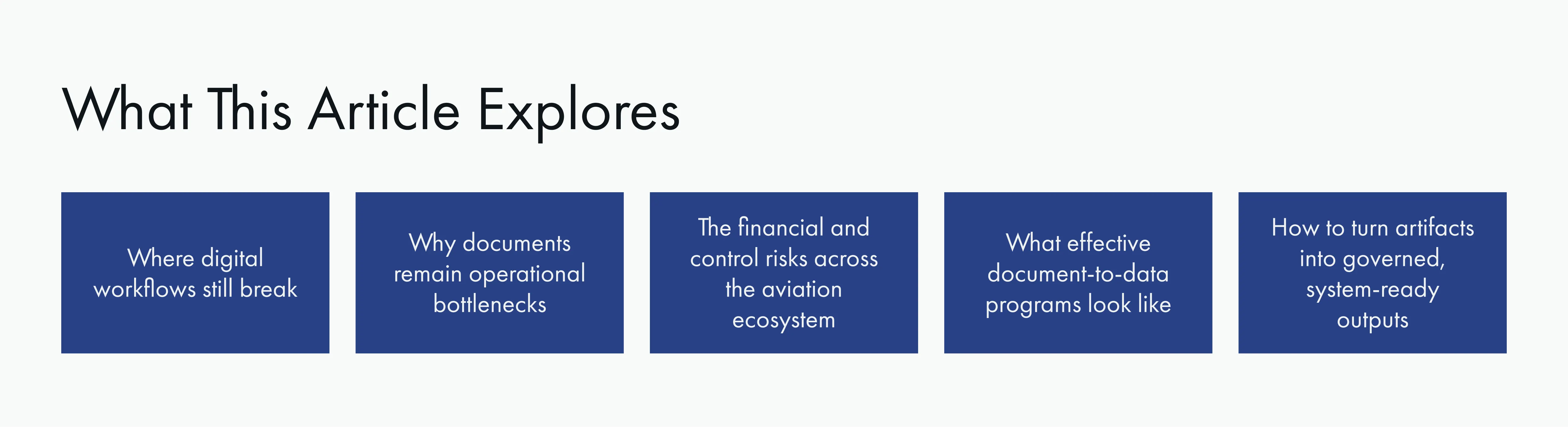
Where Digital Workflows Still Break
The visible parts of the stack are improving: order management, digital servicing, distribution integration, and customer apps. The less visible reality is that key steps still depend on document handoffs.
And those handoffs rarely stop at the single organization. A single workflow can touch airports, ground handlers, fuel suppliers, MRO vendors, finance providers, and government agencies. Each party has its own systems and formats, so the “shared truth” often ends up as a PDF, a scan, or a screenshot.
When that happens, teams re-key data because downstream systems can't validate what arrived. Exceptions get resolved in inboxes and spreadsheets. Cycles slow down, traceability weakens, and cost rises.
One industry estimate, focused on business aviation maintenance records, suggests paper use can equate to “over 1100 full-time employees per year” of extra overhead.
Fuel Invoices: A Bottleneck You Can Measure
Fuel invoices clearly show the problem: volume is high and the rules are messy.
Invoices arrive in different layouts and formats. Contract terms live elsewhere. Uplift data sits in operational systems. Airport-specific items vary by location and supplier. Small differences, such as local taxes, hydrant fees, handling charges, and currency conversions, can shift totals and trigger disputes.
So, teams do what systems can’t. They manually extract invoice data into ERPs, cross-check against uplift records and contract terms, and resolve exceptions in email. Posting gets delayed. Discrepancies slip through. Staff time gets swallowed by rework.
At scale, this becomes governance debt. You can prove the invoice existed, but not always how figures were validated, who approved exceptions, and what changed.
Why This Becomes a Control Issue
Documents sit at the boundary between obligation and evidence. When data is late, wrong, or untraceable, the organization doesn’t just lose efficiency. They lose confidence.
- Cost leakage: discrepancies slip through when interpretation is manual and time-boxed.
- Audit and control gaps: regulated environments need a defensible chain of receipt, extraction, validation, approval, and change history.
- Operational resilience: during disruption, manual re-entry becomes the constraint you can’t scale.
This is why intelligent document processing for aviation is shifting from “automation” to operational control.
What Effective Document-to-data Programs Look Like
Strong programs don’t “deploy a tool.” They build a governed workflow that turns messy inputs into validated outputs.
Start with a schema, not a model. Define which fields matter, what “valid” looks like, and what must be checked against other systems. That keeps data extraction for aviation tied to outcomes.
Make validation reviewable. The hard part isn’t extraction. It’s handling the exception path without weakening controls or slowing the business. Outputs need transparency, editability, and a clear reason when something is flagged.
Treat it as an aviation document control system, not a parser. Link each file to extracted fields, downstream transactions, approval history, and versions.
This is also where an offering matters. DataArt typically delivers document-to-data as an end-to-end workflow: ingestion from the channels teams already use, structured extraction with validation rules, human review where needed, and integration into airline, airport, MRO, and finance systems via exports or APIs.
Where Programs Typically Fail
Most failures come from assumptions, not algorithms.
Teams build for a “standard” format, then drown in exceptions as layouts drift and local variants appear. They stop at extraction, so approvals, routing, and reconciliation stay manual, and the work simply moves downstream.
They also over-trust black boxes. If the system can’t show what it extracted, why it flagged something, and how it was approved, it won’t survive audit culture.
Off-the-shelf tools can accelerate the start, but often struggle with real-world variability and audit expectations. Custom delivery can fit the workflow and controls, but only if you reduce discovery time and design for exceptions from day one.
Where This is Heading
Aviation organizations will continue to standardize and modernize, but multi-party operations ensure that artifacts won’t disappear overnight. What is becoming unavoidable is a document-to-data capability that is traceable enough for audits, stable enough for scale, and integrated enough to reduce manual handoffs across partners.
What Leaders Should Do Next
Treat documents as first-class program scope, not cleanup.
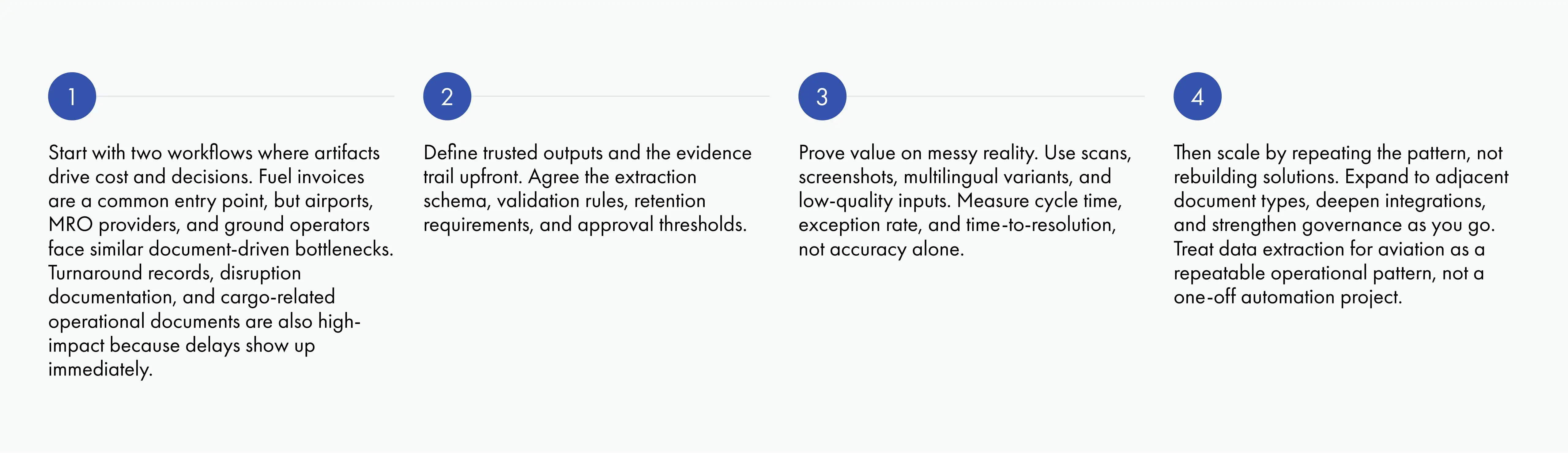
Aviation modernization doesn’t fail because teams can’t build modern systems. It fails when modern systems still depend on documents that never became data. Fix that, and the rest of the roadmap will start moving again.